One Week for French — Then a Translator?
Is This What “Bilingual Virtual Care” Means?
Last weekend, we asked a straightforward question:
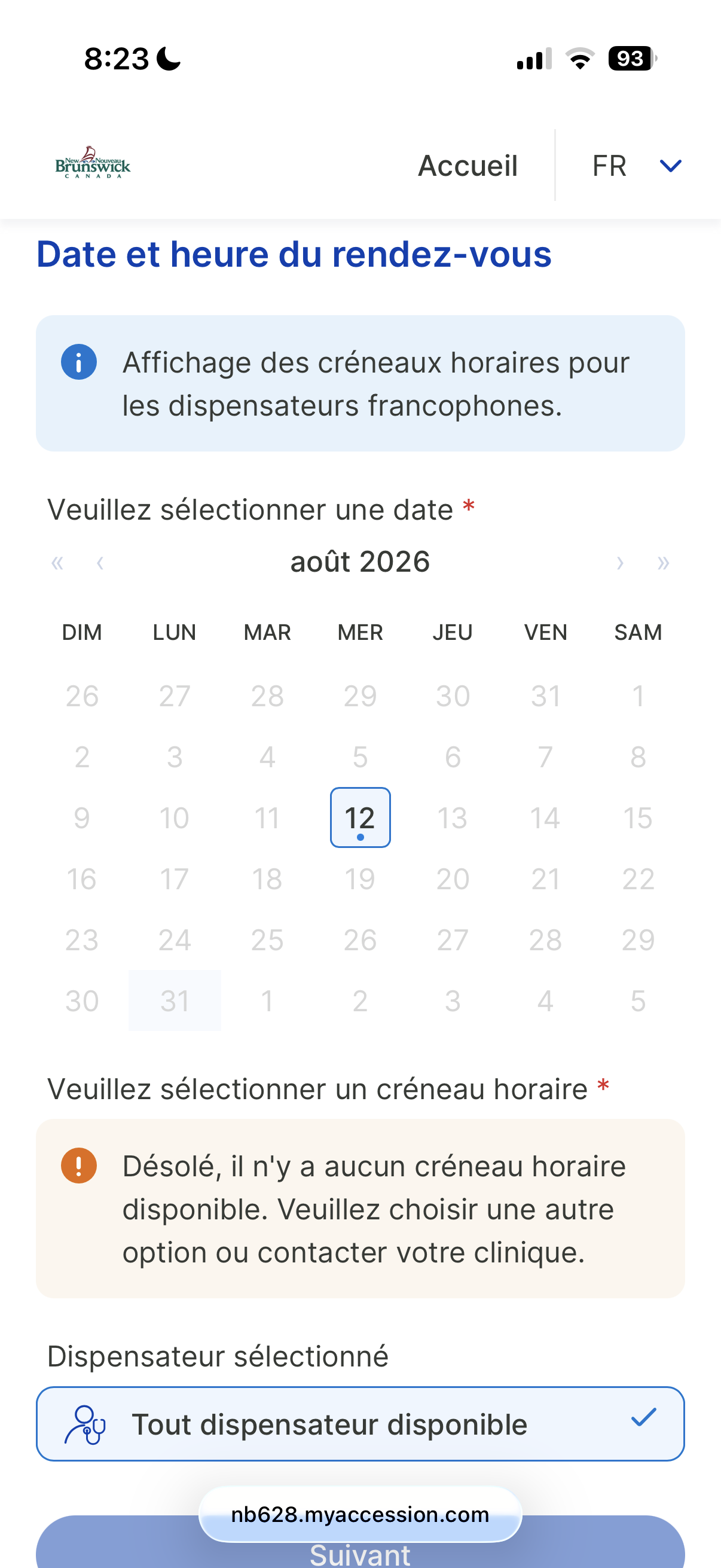
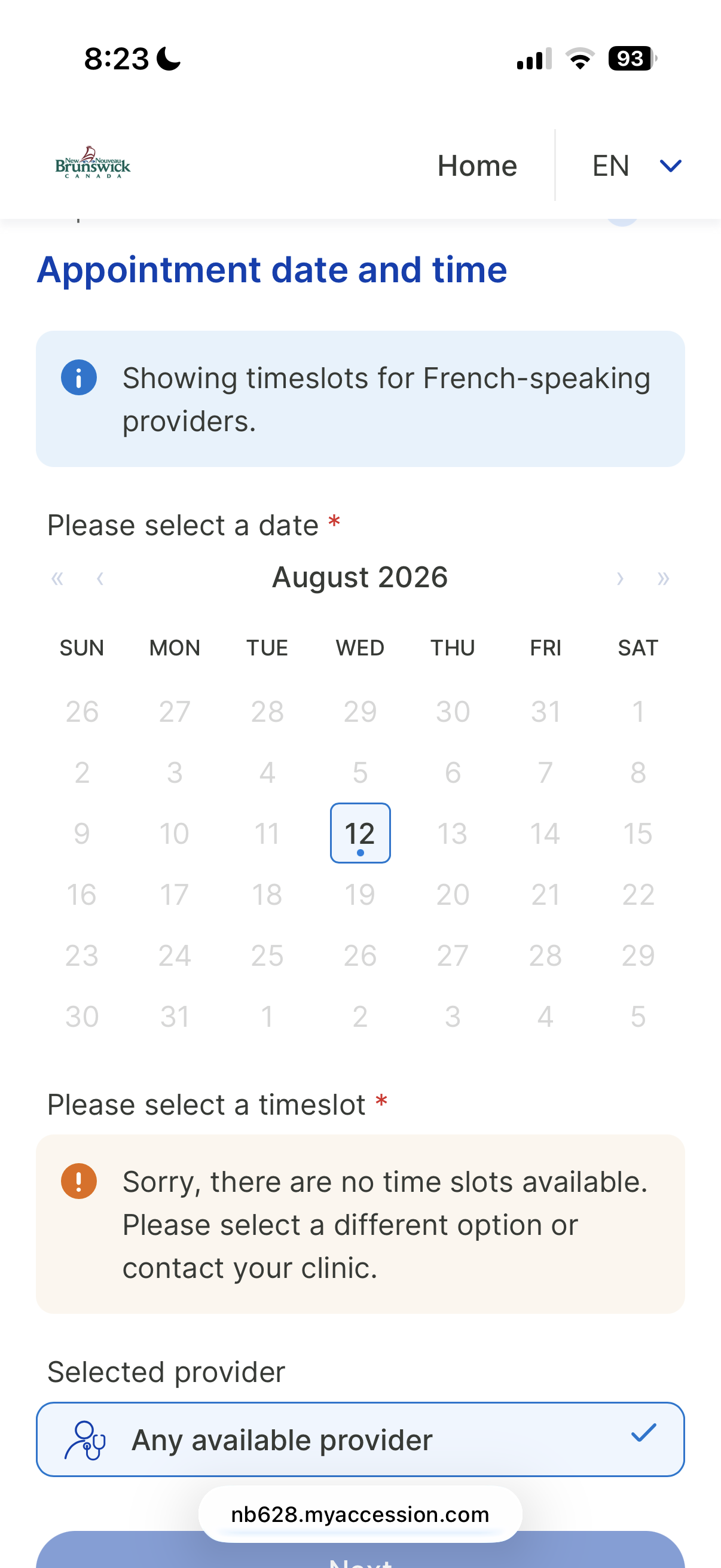
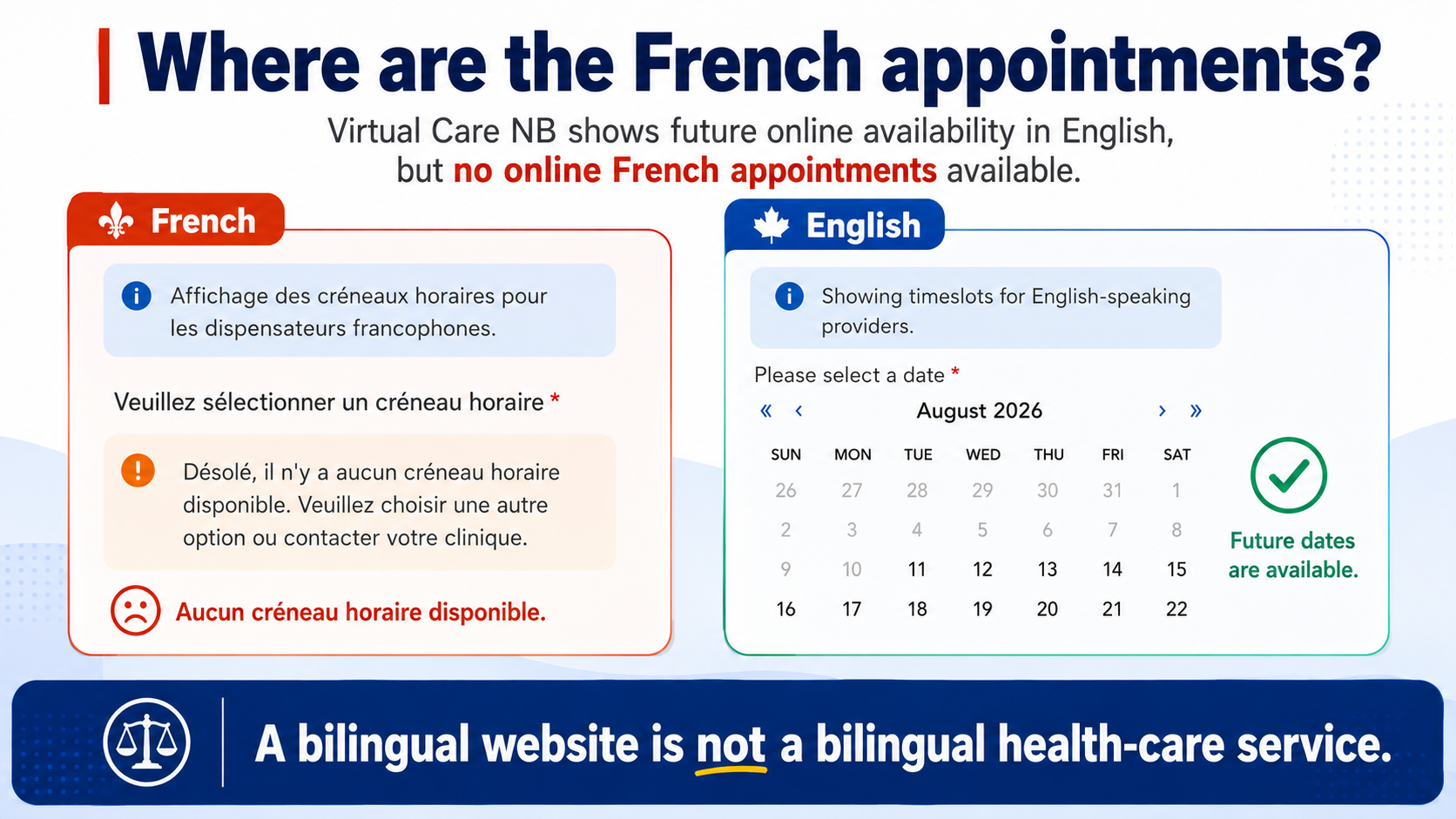
Where are the French appointments on Virtual Care NB?
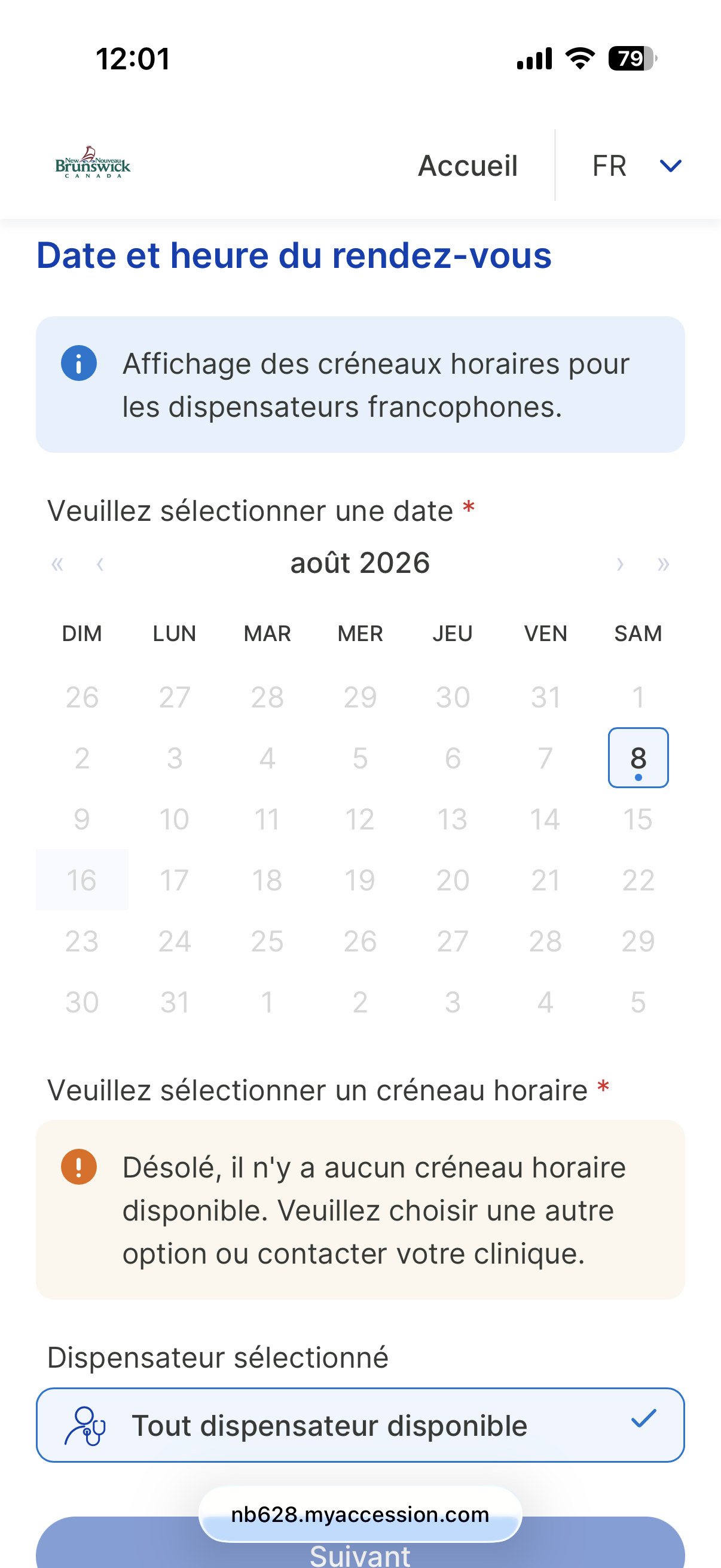
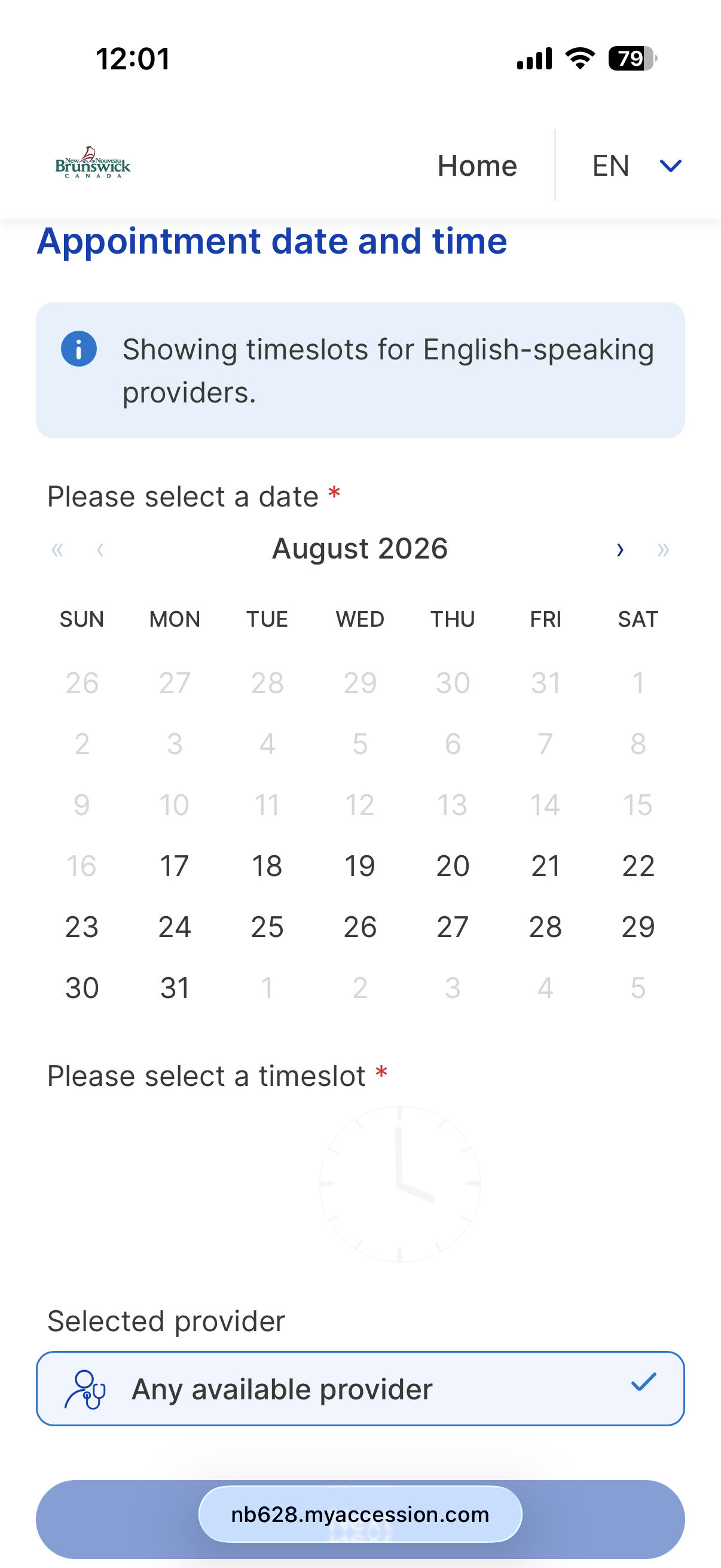
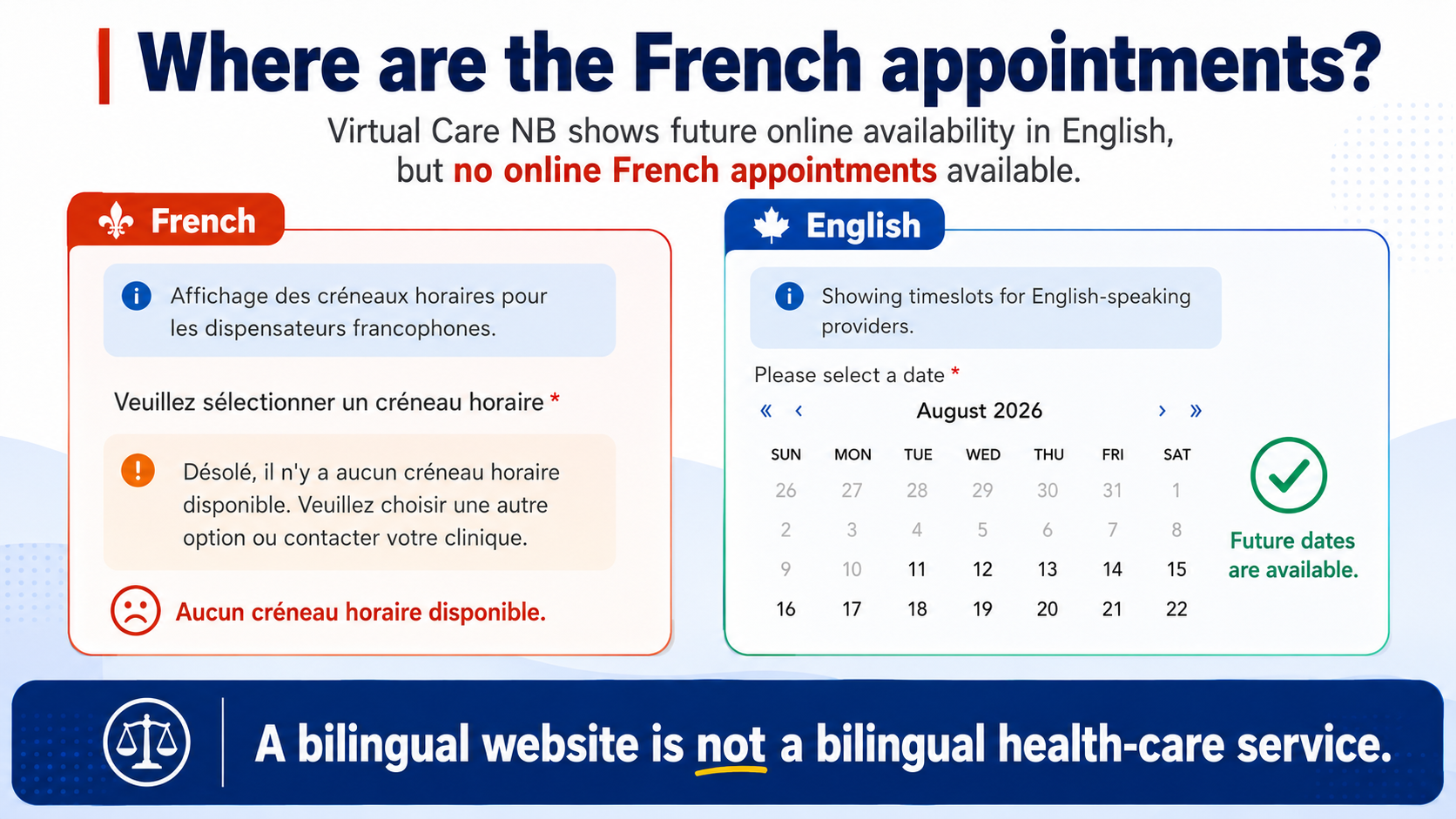
The booking system showed future appointments available in English, while no online French appointments appeared available.
Now, a Francophone New Brunswicker has publicly described what happened when she tried to obtain care.
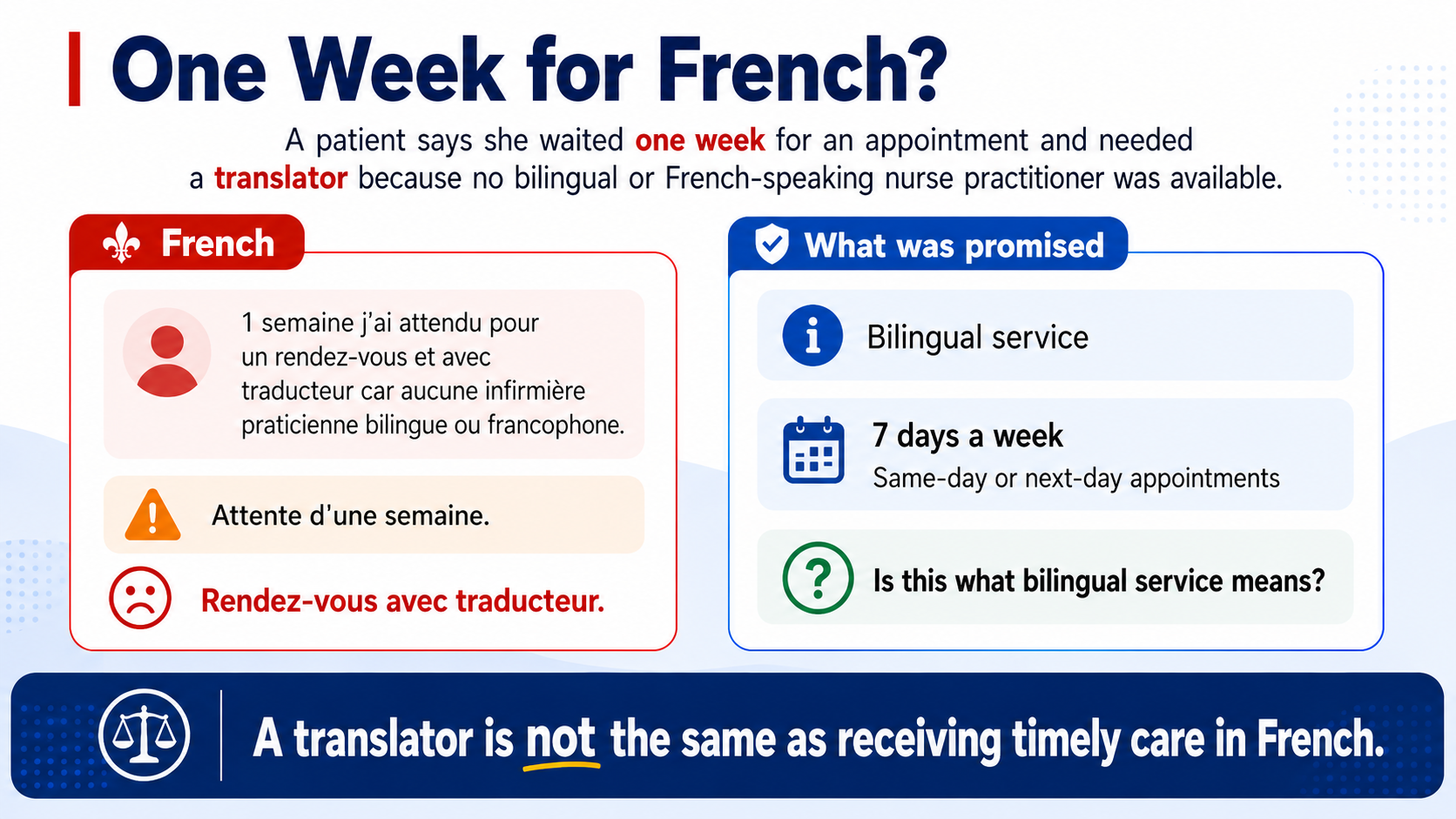
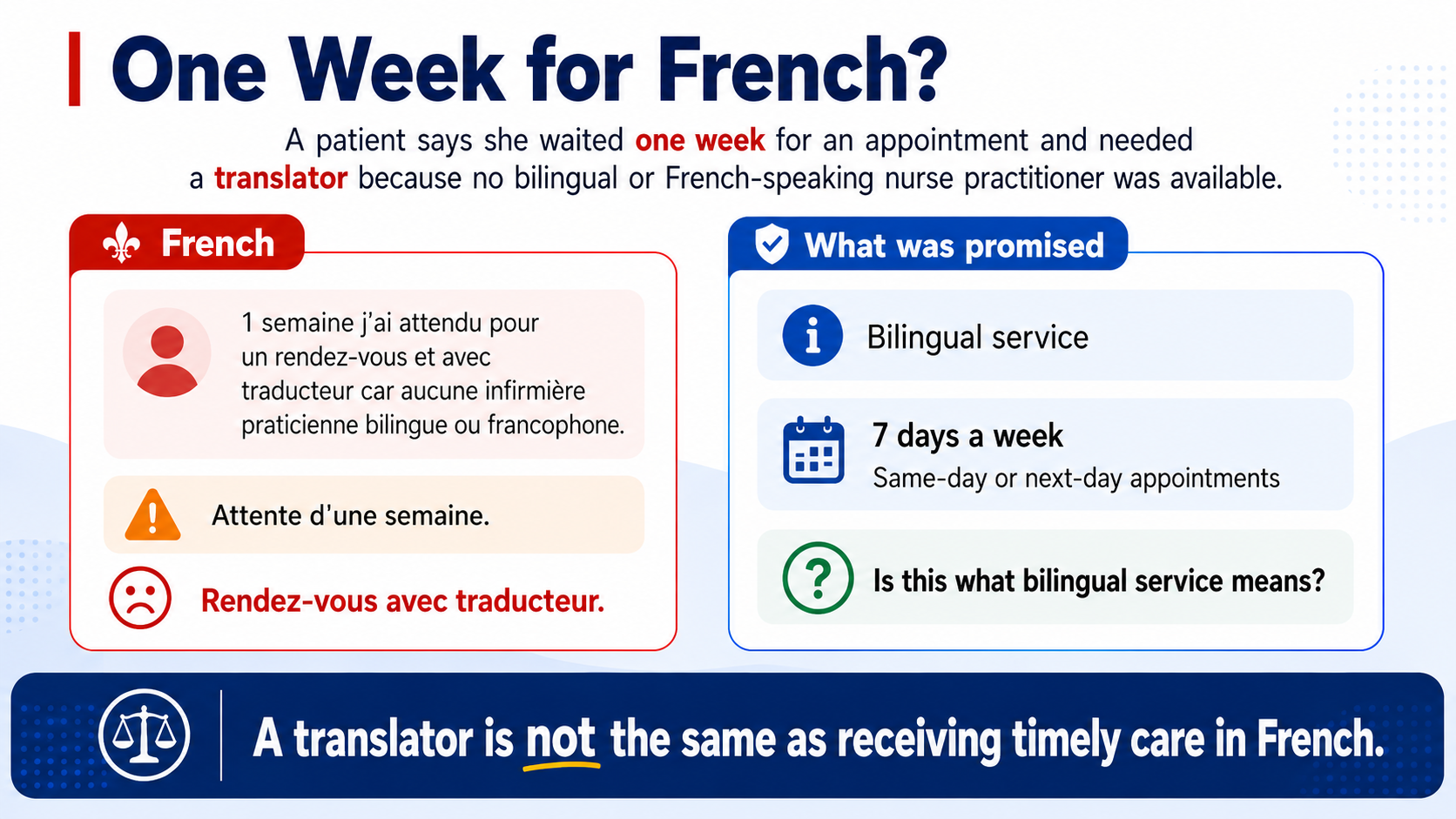
She says she waited one week for an appointment and required a translator because no bilingual or French-speaking nurse practitioner was available.
This raises an important question:
Is an appointment with a translator now considered equivalent to receiving timely health care in French?
Because that is very different from what eVisitNB was previously told by the Department of Health.
The Department of Health considered this exact issue before
On January 30, 2025, during discussions about French-language access through eVisitNB, the Department of Health responded directly to a proposal involving the use of a live translation service.
Its response was unequivocal:
“The use of a language line does not comply to the Official Languages Act for the services you are offering.”
In subsequent meetings, eVisitNB was advised that simply providing translation would not meet the required threshold for the quality and equality of the service being provided in both official languages.
In other words, a translation service was not regarded as equivalent to actually providing the clinical service in the patient’s chosen official language.
So eVisitNB changed its approach
That created a real operational challenge.
It would have been much easier to use a translation service whenever a French-speaking clinician was unavailable.
But that was not the standard eVisitNB understood the Department of Health to require.
So eVisitNB pursued an aggressive recruitment strategy focused on increasing the number of bilingual and Francophone nurse practitioners available to patients.
The objective was straightforward:
A patient choosing French should receive their health-care consultation in French — not simply access care through a translator because a French-speaking clinician was unavailable.
That took recruitment, scheduling, workforce planning and ongoing effort.
But the problem was solved.
French-speaking patients could obtain timely virtual care directly from clinicians able to provide that care in French.
What changed?
This is why the experience being reported today is so difficult to understand.
When Virtual Care NB was launched, New Brunswickers were told the service would provide bilingual services seven days a week, with same-day or next-day scheduled appointments.
Yet a Francophone patient is now reporting a one-week wait, followed by an appointment requiring a translator because no bilingual or Francophone nurse practitioner was available.
If the Department of Health explicitly told eVisitNB in January 2025 that using using a translator did not comply with the Official Languages Act for the service being offered, how can a replacement service now rely on translation when a French-speaking provider is unavailable?
Has the standard changed?
If it has, why?
If it has not, how is the current model acceptable?
This is about more than translation
Translation and interpretation services have an important role in health care.
But interpretation and bilingual clinical care are not the same thing.
There is a meaningful difference between a Francophone patient speaking directly with a French-speaking nurse practitioner and a Francophone patient communicating through a translator because no French-speaking clinician is available.
That distinction becomes even more important when the patient has already waited a week for care that was promoted as available the same day or next day.
eVisitNB was required to solve the problem — and did
When translation was deemed insufficient, eVisitNB invested in recruitment and built the bilingual clinical capacity necessary to provide timely care directly in French.
If the replacement service is now being permitted to use translation because it has not recruited sufficient bilingual or Francophone clinicians, that appears to be a fundamentally different standard.
New Brunswickers deserve to know why.
The Official Languages Act did not become less important when the contractor changed.
The expectation of equal-quality service did not disappear when the platform changed.
And Francophone New Brunswickers did not suddenly become entitled to a different standard of care.
Wasn’t the new service supposed to be better?
The replacement of eVisitNB was presented as an improvement.
But improvements should be visible in the patient experience.
If eVisitNB could provide timely access to French-speaking clinicians, while patients using its replacement are waiting a week and then relying on translation because no Francophone clinician is available, it is reasonable to ask:
What exactly has improved?
A bilingual website is not a bilingual health-care service.
A translator is not the same as receiving timely care in French.
And a standard that the Department of Health considered inadequate for eVisitNB in January 2025 should not quietly become acceptable simply because the provider has changed.
New Brunswickers deserve one standard — and it should apply equally to everyone.
Where are the French appointments on Virtual Care NB?
Where are the French appointments on Virtual Care NB?
This morning, I checked the new Government of New Brunswick Virtual Care NB booking system.
When English is selected, appointments are available on multiple upcoming dates.
When French is selected, the system says:
“There are no available time slots. Please choose another option or contact your clinic.”
That is difficult to reconcile with what GNB told New Brunswickers when it replaced eVisitNB.
GNB repeatedly highlighted access in both official languages when explaining and promoting the new service.
When the change from eVisitNB was announced, the Department of Health said the procurement was intended to ensure virtual care could continue to be provided in both official languages.
When GNB announced the Foundever contract, one of the requirements it specifically highlighted was:
“A bilingual service available seven days a week.”
Minister John Dornan subsequently told New Brunswickers that the new virtual-care model would provide care “in both official languages.”
And immediately before the service launched, GNB again publicly stated that Virtual Care NB would “offer bilingual services.”
GNB’s own Virtual Care NB webpage still says today:
“Virtual Care NB is a bilingual service.”
There is also important history here.
eVisitNB had previously faced legitimate complaints regarding French-language access. Those concerns were investigated by the Commissioner of Official Languages.
But by January 2025, the Department of Health itself reported that the corrective measures had been implemented, that there had been no new complaints, that English and French service were equivalent, satisfaction exceeded 90% in both languages, and staffing capacity existed in both official languages for every shift.
Despite that, bilingual access was repeatedly highlighted by GNB as an important feature of the service replacing eVisitNB.
So the question today is simple:
How is it acceptable for the replacement service to show appointments available in English while offering no appointments at all in French?
Minister Dornan promised New Brunswickers a bilingual health-care service, not simply a bilingual website.
Being able to read a booking page in French is not the same as being able to receive health care in French.
If this is a temporary problem, GNB should explain what happened and when French-language appointments will be restored.
If it is not temporary, then New Brunswickers deserve to know how a service specifically procured, promoted and launched as bilingual seven days a week can operate with English appointments available and apparently nothing available in French.
A bilingual website is not a bilingual health-care service.
And if French-language access was important enough for GNB to highlight when replacing eVisitNB, surely it is important enough to actually provide now.